Strategies in Buildings to Protect Agains Active Shooters
Introduction
Within This Page
- Introduction
- Description
- Application
- Emerging Issues
- Boosted Resources
The tragic homo consequences of active shooter events at present play out through the media to which the public is continuously continued. While this is definitely a real phenomenon that shakes the foundations of one'southward sense of security; panic and paranoia are non in order. After all, the chances of any specific individual being the victim of an active shooter are extremely small; on boilerplate approximately 135 people killed or wounded annually in the US, according to FBI data. People are much more probable to die in a car accident (approximately 38,000 annually). The fatality figure from active shooters is even smaller, at approximately 49 per yr. To put that in perspective, according to the National Atmospheric condition Service, the aforementioned number of people are killed by lighting in the US annually. Withal, the horror that the active shooter instills mandates that a person act. People want to experience safe, notwithstanding don't desire to surrender their liberty and freedom. Schools, malls, and offices should non be turned into high security, hardened facilities. So what tin prudently be washed to reduce the chances of being a victim? A programme and grooming meliorate reaction time and reduce the chances that poor choices will be made under stress. Some selective hardening can assistance reduce the damage and number of victims if an event does occur. Delaying an attacker past mere seconds or minutes tin can salve lives in an agile shooter assail.
Clarification
Protective design tin can reduce the risk of an active shooter incident and, if one occurs, tin can mitigate or reduce the number of potential victims. The extent of the design may vary greatly depending on the type of organisation, the openness requirements of the facility, the bodily or perceived threats, the tolerance for visible (perhaps intrusive) security measures, and funding. Withal, fifty-fifty for soft targets similar schools, malls or office buildings, prudent steps tin can and should be considered. A facility, school, or office building should carry a security risk cess. Such an assessment can be performed by a qualified security consultant or company, or local law enforcement. Requiring credentials such as PSP (Certified Concrete Security Professional person) or CPP (Certified Protection Professional person) past the American Order of Industrial Security (ASIS) or like credential is a good style of ensuring a audio assessment is performed. The assessment should evaluate the threats, identify vulnerabilities to those threats, quantify the potential loses, evaluate the relative risks, and recommend measures to mitigate these risks. Such measures may exist operational, technical, or architectural in nature. An contained party (not a vendor seeking to sell specific systems) will generally provide a more unbiased and comprehensive assessment.
When evaluating design considerations, the concept of CPTED (Law-breaking Prevention through Environmental Design) is a skilful place to kickoff. It is normally described as a multi-disciplinary approach to deterring criminal behavior through environmental blueprint. CPTED strategies rely upon the power to influence offender decisions that precede criminal acts. It requires application of psychology as well equally sound security pattern. CPTED includes common sense approaches of ensuring acceptable lighting, eliminating hiding places, etc. that tin amend security, reduce vulnerability, and assist deter criminal action.
Equally evidenced by the statistics, many active shooters are set on destruction, and their own mortality is non a concern. They never intend to get out of the assault live. This tin limit the value of deterrence. Notwithstanding, many active shooters, especially those who plan their actions carefully, want their plans to succeed. Even suicide bombers have been known to avoid sure targets because they fear they'll be stopped or interdicted prior to completing their mission. A robust security posture and presence can certainly aid in this regard. For lightly protected facilities similar schools, malls, and function buildings, this may be limited to such things as visible signage, random guard patrols, adequate lighting of exterior parking and entrance areas, airtight circuit idiot box (CCTV) cameras, substantial exterior door locks, simple access control systems (turnstiles, badges, etc.), and secure locking doors to key areas or passageways.
Ultimately, in that location are two options: impede the shooter or impede the bullet.
More than options are available for protecting against an external threat versus an internal threat. For external threats, access control is key. Minimize the number of access points and condition building occupants to not bypass security measures for convenience. Verifying entrants is important. Where security officers are non present, building administrators, particularly in schools, should exist the first interface with visitors. Unfortunately, many schools are designed with administrative offices buried inside and not out and visible to a company. Forcing an exterior threat through an authoritative space, with restricted access to the cadre of the building, could deter or forestall the aggressor from reaching their targets.
While there is a vast array of intrusion detection systems available today, people'due south eyes and ears tend to be the near reliable especially in an open, non-hardened, publicly accessible facility. As a minimum, however, solid security locks and doors are essential. These may be coupled with sensors to find motion or unauthorized access. If they are to exist more than simply a deterrent and delay device, these sensors should besides necktie back to a central reporting station for interpretation and action.
Alarms are essential and must get across the basic fire alarms used in the by. Studies conducted on the evacuation of large public facilities have conspicuously shown that the efficiency of large-calibration evacuations are increased substantially when aural alarms giving simple verbal directions are provided compared to a full general klaxon-type alarm. This is particularly so in an active shooter situation where specific directions to staff or occupants may improve survivability. If, for example, an aggressor is located in the cafeteria of the building, it would be beneficial to direct people away from that area. In contrast to a burn down evacuation, measures for alert during an active shooter event should include letters to employee computers, text messages, etc. Audible directions which the aggressor could hear are discouraged, unless they are communicated in code (i.east. Code Blue). However, in some environments, an audible message may be the simply option to provide facility occupants with the information they demand to protect themselves.
Since nigh active shooter events generally last only minutes, access denial can be an effective way to mitigate potential losses. Slowing or delaying an aggressor by just a minute or seconds may give law enforcement fourth dimension to go far before mass casualties are incurred.
For lightly secured facilities, a significant return on investment can generally be obtained by implementing reinforced doors lockable from the interior of office spaces or gathering areas. Secondary door blocking devices such as a simple rubber or wood triangular stop can provide additional stopping resistance. Those doors should have small slit windows, likewise small for an aggressor to crawl through. No windows are preferred just are not practical for other reasons. It is important even so that if windows are present that they comprise laminated glass that provides some resistance to ballistics attack and forced entry. If a gunman can shoot through the window it is important that he cannot just reach in and unlock the door. This is where simple door stops or floor angles provide needed secondary protection. Analysis of footage from actual agile shooter events take shown that the shooter will likely not spend meaning time trying to get through a detail door if it is locked or blocked. Rather they move to their side by side target. They know law enforcement is on its fashion and that time is express.
The technology and materials to provide boom, hurricane, forced entry, and ballistic-resistant door and window systems exist. These systems have been designed, tested, and implemented in highly secure facilities like embassies, courthouses, government buildings, military facilities, sensitive data centers, and facilities housing, historic or otherwise valuable assets, for many years. Providing this level of protection in more lightly secured facilities like schools, malls and typical role buildings is often not practical, cost-effective, or even desired by the occupants given the level of threats and risks perceived. However, some level of protective glazing, especially for windows and doors near lobbies and other entrances offer a potential area where simple improvements can provide significant do good. In the Sandy Hook Schoolhouse shooting for example, it was reported that the shooter failed to gain entry through locked doors and shot out side by side windows. This is shown in Figures i and ii.
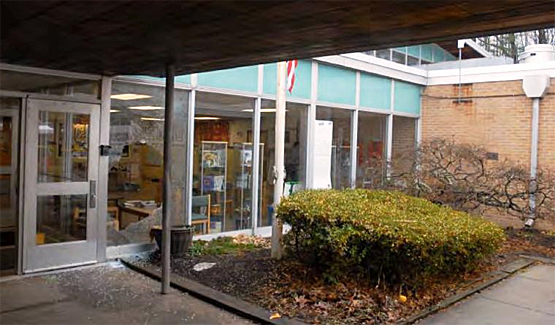
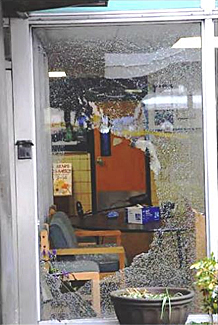
Figure 1: Entranceway with window cleaved out at Sandy Hook School
(State Police Photo)
Figure 2: Close-up of window adjacent to door in Figure i
(State Constabulary Photo)
Test data nerveless in projects supporting the Department of Homeland Security (DHS) and the U.S. General Services Assistants take clearly demonstrated that some applications of properly installed security window films and thin laminated glass systems tin provide resistance to forced entry even though they were not specifically designed for that purpose.1 These tests were conducted in response to the U.South. Authorities'south business concern that upgraded window systems in their facilities designed to resist hurricane wind and explosive blast forces might hinder commencement responders in gaining access to or emergency egress from protected spaces. This trunk of data was fabricated freely available to firefighters resulting in over 5,000 trained start responders (Figure iii). The test program produced a window classification system to train firefighters how to enter and egress through such window systems. The nomenclature system is shown in Table 1. The data should now exist extended, analyzed, and fabricated available as a resource for facility owners and security designers for the purposes of evaluating the benefits of lightly protected glazing systems.
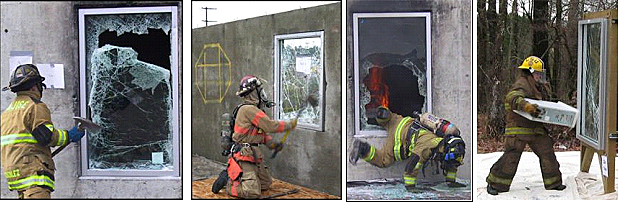
Figure 3. Firefighters using various objects, tools and techniques to breach protective glazing systems
Table 1. Window nomenclature system developed for the U.Due south. General Services Administration and the U.Southward. Department of Homeland Security. The organization classifies window systems based on the type of tools required to alienation the glazed arrangement in a given period of fourth dimension.
| Window Type | Clarification | Average Clearing Fourth dimension |
|---|---|---|
| Type I | Paw Tools (HT) | 10 seconds to 1 minute |
| Type II | Hand Tools or Power Tools (HT/PT) | 1 to 3 minutes |
| Type IIA | Type I Window with Interior Textile System or Interior Type Ii (HT/PT) | i to 3 minutes |
| Type Iii | Power Tools Simply (PT) | Typically 3 to five minutes only could exist more |
For both external and internal threats, edifice design can be beneficial. Moving picture or laminate glazing applied to both exterior and interior windows may not stop a bullet, only it could significantly slow an aggressor. This is particularly important given the current architectural preference for big amounts of glazing to provide natural calorie-free into spaces. Obscuration is another arroyo. Adding opaque materials, where feasible, reduces an aggressor'southward line of sight and provides more hiding locations for building occupants. Finally, structural materials tin play a significant office. Concrete masonry units (CMU) and masonry bricks are usually used in construction and based on initial testing provide suitable ballistic resistance. CMU is highly effect if the hollow cores are infilled with concrete to create a solid wall. These materials can also exist used for interior walls to provide more barriers from a ballistic threat. A combination of these materials and strategies, designed specifically for the space, can provide both a deterrent and a mitigation arroyo.
Just as potential victims must process through an OODA Loop where they Notice, Orient, Decide, and Human action, then must the active shooter. When an assailant hits a window system for example, expecting it to easily break and it doesn't, this disrupts their processing of events. They have to make decisions. Do they continue to assault to interruption through? Practice they change course and approach by a unlike route? If they start trying to break through such a window system that may have a minute or two to get through, do they continue or exercise they surrender? Regardless of the effect, such systems tin provide disruption and delay. Maybe plenty time for escape and for police force enforcement to arrive. Remember, seconds or minutes can brand a tremendous difference in an active shooter upshot.
Application
Designing for an active shooter issue tin be performed in about any environs and to varying degrees. Schools are the current focus of resources for mitigation measures due to the perceived loftier frequency of events and the natural reaction to protect our children from damage. Regime and commercial entities are also beginning to focus on active shooter design, particularly at points of public interface such equally lobbies.
Emerging Issues
The lack of guidance documents focusing specifically on active shooter designs will likely atomic number 82 to varying levels of implementation and reliance on methods and technologies which may not be as constructive or cost efficient.
Additional Resources
Publications
- Active Shooter How to Reply by the U.Due south. Department of Homeland Security, October 2008.
- Active Shooter Pocket Bill of fare by the US Department of Homeland Security.
- Active Shooter Recommendations and Assay for Gamble Mitigation by Raymond W. Kelly, NYPD.
- "Active Shooter: What to await, what to do, is at that place a role for protective design?" by Joseph L. Smith, PSP, Applied Inquiry Associates, Inc., April ix, 2014. The material on this page is excerpted from the paper.
- Firefighter Forcible Entry Tutorial past Applied Research Associates, Inc., Prepared for the U.Due south. General Services Administration with support from the U.South. Department of Homeland Security and Louisiana State University, 2005.
- RUN, HIDE, FIGHT! This grooming video is made available by the Urban center of Houston, TX with support from the U.S. Section of Homeland Security.
Training Courses
- WBDG03 Planning for Secure Buildings
- WBDG10 Seismic Pattern Basics
- WBDG11 Site Security Blueprint Process and Strategies
Source: https://www.wbdg.org/resources/active-shooter-role-protective-design
0 Response to "Strategies in Buildings to Protect Agains Active Shooters"
Post a Comment