Art Deco New York Style Art Art Nouveau New York Style Art
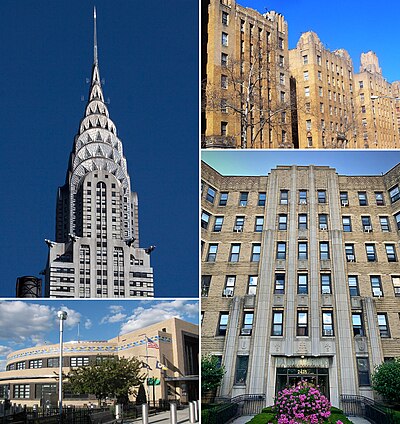
Clockwise from top left: The spire of the Chrysler Edifice, one of Manhattans's most recognizable skyscrapers; Terracotta "frozen fountain" motif on the Park Plaza Apartments in the Bronx; entrance of Madison Gardens apartments in Brooklyn; and the interior of the Marine Air Terminal in Queens.
Art Deco architecture flourished in New York City during the 1920s and 1930s, before largely disappearing after Earth War 2. The manner is plant in government edifices, commercial projects, and residential buildings in all five boroughs. The architecture of the menstruation was influenced not simply by decorative arts influences from across the earth, only also local zoning regulations.
Their proliferation fueled past the Roaring Twenties and commercial speculation, Fine art Deco buildings in the urban center range in size and sophistication from towering skyscrapers and part buildings to modest heart-grade housing and municipal buildings. First defined by the colorful, lavishly-busy skyscrapers of Manhattan, the Great Depression and changing tastes pushed Art Deco to more than subdued applications in the 1930s. The lull in construction during World State of war 2 and rise of the International Manner led to the end of new Fine art Deco in the city.
Afterwards falling out of favor and suffering from neglect during the city'southward downturn in the latter half of the 20th century, New York's Art Deco has been reappraised; amid its about treasured and recognizable buildings are the Art Deco Empire State Building and Chrysler Building, and Art Deco skyscrapers formed the core of the metropolis's skyline. Today, many of New York's Art Deco buildings are protected by celebrated preservation laws, while others have been lost to evolution or neglect.
Introduction [edit]

American Art Deco has its origins in European arts, especially the mode moderne popularized at the 1925 International Exhibition of Modern Decorative and Industrial Arts from which Fine art Deco draws its name (Exposition internationale des arts décoratifs et industriels modernes). While the United states would not officially participate, Americans—including New York City architect Irwin Chanin[1] : 55 —visited the exposition,[2] : 47 and the authorities sent a delegation to the expo. Their resulting reports helped spread the style to America.[3] : 6 Other influences included High german expressionism, the Austrian Secession, art nouveau, cubism, and the decoration of African and Central and South American cultures.[1] : 8–nine [4] : 4 In America, Art Deco architecture would accept on dissimilar forms in dissimilar regions of the country, influenced by local culture, laws, and tastes.[ii] : 42
Art Deco came into style just as New York itself was being rapidly transformed. An exploding population, affluent economic times, inexpensive credit, and lax zoning combined to encourage a edifice nail. The real estate marketplace was so frenetic that old buildings were regularly torn down for new structure after standing for but a few years.[5] : 42 Builders tore down twice equally many buildings equally went upward, with the new buildings occupying two or more former lots. The result was that the corporeality of function space in New York Urban center increased by 92% in the dorsum half of the 1920s.[5] : 49–50
In New York Urban center specifically, zoning regulations had major impacts on the design of its buildings. The evolution of the elevator and steel-framed buildings enabled the construction of buildings far taller than always before—the skyscraper. The rise of always-larger skyscrapers such as the xl-story Equitable Edifice helped spur the passage of the U.s.a.' first citywide zoning code, the 1916 Zoning Resolution.[6] The regulations, intended to forestall tall buildings from choking out light and air at street level, required tall buildings to "set back" from street level depending on the width of the street and the zoned surface area.[7] Once a building rose up and set back to cover just 25% of the lot, clients and architects were express not past city codes only past money and engineering as to the summit of their projection.[five] : 48 The impact of the new regulations was not felt until subsequently in the decade, as the entry of the United States into World War I slowed construction.[7]
Early buildings built to conform to the new setback codes did so unimaginatively—the Heckscher Building in Midtown (completed 1921) ready back evenly like a stack of boxes as information technology rose—but more than novel interpretations of the law would follow.[vii] A major influence on the resulting skyscrapers was Finn Eliel Saarinen'south second-place entry for Chicago's Tribune Tower, considered a liberating culling for a skyscraper mode unbeholden to either Gothic or Classical architecture.[2] : seven–8 Too influential were builder and illustrator Hugh Ferriss' serial of speculative architectural illustrations exploring how to make buildings that met the zoning requirements.[4] : four [7] [8] Ferriss' illustrations envisioned buildings every bit sculptural forms rather than unproblematic boxes. Builder Talbot Hamlin described Ferriss' piece of work as "a magic wand to ready the American metropolis architecture complimentary from its nightmare [...] No longer was the high building plain built by the mile and cut off to club, but it was composed intermission upon break, buttress on buttress. The possibilities of poetry entered in."[5] : 48–49
Precursors to the Fine art Deco skyscrapers that would soon get upwards across the city were buildings such every bit Raymond Hood's American Radiator Building, which was neo-Gothic in general style just featured abstruse decoration that would characterize Art Deco.[9] Another early on transitional building was the Madison Belmont Building at 181 Madison Avenue (1924–1925), which featured traditional ornamentation and organization on upper floors, combined with Art Deco motifs on the lower floors. The ironwork was provided by Edgar Brandt, who contributed the entrance gates to the 1925 Paris Exhibition.[3] : 1, five–6
Art Deco in the city [edit]
Vertical way [edit]
New York has such courage and enthusiasm that everything can be begun again, sent back to the building yard and made into something yet greater, something mastered! [...] In reality, the metropolis is hardly more than twenty years old, that is the urban center which I am talking about, the city which is vertical and on the scale of the new times.
Architect Le Corbusier, 1936[1] : 77
The buildings that would become described as Fine art Deco shared several elements. The setback laws resulted in three-dimensional, sculptural buildings, with long, uninterrupted piers ascent between columns of windows and decorated spandrels.[4] [x] These choices were fabricated to emphasize the height of the buildings,[two] : 37 a choice mimicked even on much shorter buildings built across town. New York's architects were at the forefront of using new materials, including synthetics like Bakelite and Formica plastics, besides every bit Nirosta, a corrosion-resistant steel alloy that made exterior metal on skyscrapers more feasible.[four] [2] : 68 Aluminum's failing price and lighter weight than steel led to it being a common selection for interior and exterior usage.[eleven] Other favored materials were brick and multicolored terra cotta.[four]
Architectural historian Rosemarie Haag Bletter described the most pronounced chemical element of Art Deco every bit "its use of sumptuous ornament". The most dynamic elements were reserved for entrances and at the tops of buildings, with multiple materials combined to course dazzling colors or rich texture. Sometimes the buildings were shaded—using darker-colored materials at the base, so gradually lightening towards the height—to increment the building's visibility.[2] : 37 Art Deco buildings in the city were also richly appointed inside and out with reliefs, mosaics, murals, and other fine art.[i] Allegorical depictions—such every bit beehives of manufacture on the French Building, personifications of virtues at Rockefeller Middle, or figures portraying manufacture and the arts at the International Magazine Edifice—were mutual decorative elements.[i] : 47, 72 The entries and lobbies of these skyscrapers often drew direct influence from the painted sets and stages of theaters, with framing like hanging curtains.[2] : 10
Architect Ely Jacques Kahn commented in 1926 on the emerging manner that his brethren were creating with their buildings:
[It] is and so characteristic of New York that it would exist more logical, by far, to call it a New York Style. [...] Ornamentation becomes a far more precious matter than a collection of dead leaves, swags, balderdash's heads and cartouches. It becomes a ways of enriching the surface with a play of light and shade, voices and solids. [Today's ornamental forms] respond to the bulk and simplicity of the skyscraper itself.[4]
Deco in New York became intrinsically linked with commercial architecture. Its focus on rich ornament and sensory appeal appealed to commercial patrons who wanted an "acceptable" modern fashion. These developers in plough gave architects a permissive mandate to create in the style, equally long as the end result was not likewise shocking.[ii] : twoscore–43 The buildings rose to the acme where the cost of added space equalized with the commercial value of that infinite.[2] : 13 The emerging style was contemporaneously called the "vertical manner", "skyscraper style", or simply "modern",[iv] with the characteristic look of setback buildings leading to them being called "wedding block" buildings.[10] : 79 [12] : 164

Detail from an archway to 70 Pino Street, featuring aluminum spandrels with geometric decoration and a miniature limestone model of the building itself.
The demand for modernistic buildings was such that even architectural firms known for more restrained and classical designs adopted the new style. Cross & Cross's main practice was for unimposing townhomes and banks, but in the belatedly 1920s they produced modernistic skyscrapers such as the RCA Victor Building. The l-story skyscraper turned Gothic tracery into stylized lightning bolts.[xiii] Some other conservative firm that moved to mod designs was Walker & Gillette, whose all-time-known Art Deco edifice in New York is the Fuller Building.[4] Buildings already existence constructed were sometimes appended with Art Deco flourishes; the Paramount Edifice (1926) had an Fine art Deco clock tower appended to a Beaux-Arts base.[2] : appx 22B These buildings were constructed either equally headquarters for established and emerging companies, or else speculative projects where coin would be drawn from renting out the space in the new building. The pattern of speculative buildings was chiefly driven by maximizing rentable space, whereas corporate buildings served as advertisements for the corporations themselves—in some cases, sacrificing revenue for what architect Timothy L. Pflueger termed "special architectural appeal". Even with these corporate buildings, however, the owners would often lend space to smaller businesses and care for them as real estate investments.[xiv] : 162–163 The very buildings often spoke to the business conducted in that location. The RCA Edifice's wave motifs represent the power of radio, while the Chrysler Edifice would take ornamental touches of radiators and hubcaps for the automobile company.[4] With the McGraw-Colina Building,[ane] : 61 Wyndham New Yorker Hotel, and Daily News Building, the buildings characteristic their names in prominent signage or embedded into the very facade. Because the true shape of the building was oft hard to grasp for a street-level observer, many of the skyscrapers featured miniature versions of the edifice itself as part of their ground-level decoration.[15] : 37 [4] [sixteen]
In the Financial Commune and downtown Manhattan, the skyline was quickly transformed by the proliferation of Art Deco loftier-rises.[4] : half dozen Arguably the showtime Art Deco skyscraper was the Barclay-Vesey Building at 140 West Street, built from 1923 to 1927 and conceived by Ralph Thomas Walker. Its exterior was busy with motifs derived from Aztec designs, and the lobby featured a vaulting ceiling with frescoes detailing the history of communication.[1] : 111 Other notable Art Deco skyscrapers in downtown include the Irving Trust Visitor Building (1929–1931), designed with a "curtain" exterior and Hildreth Meiere-produced mosaics in the interior;[i] : 99–102 120 Wall Street (1929–1930), with classic wedding-cake form and a red granite and limestone base;[17] : 71 and the City Bank-Farmers Trust Building, featuring abstract heads along the facade looking down at street level, and bronzed doors featuring transportation methods.[i] : 106–109 The final skyscraper built earlier Earth War Two in the Financial District was 70 Pine Street, built 1932.[1] : 102 It featured unique double-deck elevators servicing two antechamber floors, designed to maximize the profitable infinite of the minor plot.[iv] [16] In comparing to downtown, which already had skyscrapers dating to the previous century and fewer available plots, Midtown Manhattan was only just kickoff to develop its skyline equally Art Deco became popular, with its business district booming after the construction of 1000 Key Terminal and the undergrounding of previously-exposed railroad train tracks opening upwards new plots for evolution. 42nd Street became Midtown's major Fine art Deco thoroughfare, hosting some of the urban center's most famous skyscrapers.[4] : 75
New York's architects were caught in a furious race for the championship of tallest building in the world, and several Art Deco buildings vied for the title. By the stop of 1930 there were more than 11 building plans on file of more than 60 floors; among them were the Chrysler Building and the Empire State Building, both of which increased in height from their 1928 and 1929 plans, respectively.[18] In competition with 40 Wall Street for the title of tallest building, William Van Alen secretly constructed the Chrysler Building's 185 foot (56 thousand) steel spire within the edifice itself, hoisting it and securing it into position in a single day, claiming the title of tallest building.[4] The triumph was short-lived; a calendar month later Al Smith updated the plans for the Empire State Building,[19] adding more than stories and a 200-pes spire of its own and then that dirigibles could moor there.[20] The Chrysler Building would remain the tallest building in the earth for merely eleven months before being overtaken past the Empire State Building.[iv] [21]

The Empire State Edifice towers above the New York skyline in 1937. The many unoccupied and unlit floors of the building tin can be seen; the edifice would not be profitable until later on World State of war Two.[5] : 62
The Chrysler Building'due south spire went up simply i day before the Oct 1929 Wall Street Crash that triggered the economic turmoil of the Great Depression. The immediate touch on of the Low was a precipitous contraction in building of all kinds; one architectural firm went from 17 filed plans for buildings upwardly to thirty stories in 1929 to just three plans in 1930, the tallest being four stories.[22] The scope of some existing construction was also downsized; the Metropolitan Life Company intended to capture the championship for tallest building with the Metropolitan Life North Building, merely construction stopped during the downturn and never resumed, leaving it an "enormous stump" of 31 stories instead of the planned hundred.[4] : 56–7
In the shadow of the deepening Low, the Metropolitan Opera abandoned its plans to move to a new 3-block circuitous financed by John D. Rockefeller Jr. Rockefeller decided to continue with the project, hiring three different architectural firms, including Hood and Harvey Wiley Corbett, who would exit the project to piece of work on the ill-blighted Metropolitan Life North Edifice. The architects envisioned a program for buildings arranged on several axes, clad in the aforementioned materials, windows grouped in vertical columns, and k entrances. At the center was 30 Rockefeller Plaza. The buildings on the wings of the m entrance were occupied past foreign governments (French, British, and Italian), who decided on the ornament for the building.[4] The Rockefellers earmarked $150,000 ($2,433,167 adjusted for aggrandizement) for fine art in the plaza lone, filling the space with paintings, reliefs, and sculptural forms.[1] : 16 The decorative features focus on the achievements of humankind, mythology, and stories of education and commerce.[i] : 18, 33
Commercial [edit]
The heyday of Art Deco skyscrapers was finer ended by the Great Low, but Fine art Deco had proliferated outwards across the city in myriad forms.[23] [4] : vii Art Deco proved a pop style for an expanding range of mod commercial edifices that proliferated during the period—department stores, news offices, and transportation.[23] [ii] : 24 The initial prevailing wisdom was that the real estate market would quickly recover equally the stock market had drained capital from structure.[24] To tide landowners over until economic conditions improved, many built "taxpayers" on their lots—single or 2-story buildings. Despite beingness intended as temporary, many of these buildings remained for decades afterward.[25] One such Art Deco taxpayer was the Eastward River Savings Bank on 22 Cortlandt Street, which replaced a fifteen-story edifice from the 1890s. The New York Times dubbed the lot "the virtually valuable piece of New York real estate for a tax payer in the city." Despite being a more minor edifice, the structure is appointed with polished stone eagles, interior marble, and at one time featured a 3,000-square-human foot (280 mtwo) mural of the East River.[4] Completed speculative buildings faced issues in the difficult economy—the Empire Country Building took more in as a tourist attraction than from tenants, and office buildings across Midtown felt pinched by the Rockefeller Heart's aggressive tactics to lure and proceed tenants.[five] : 58
As the 1930s progressed, the rental market began to amend, and the pace of construction increased.[26] The buildings that went upwards in this period tended to be more reserved, with grayer, more austere versions of Art Deco; Bletter suggests that this change was due to the lush, colorful expect of the earlier style appearing "frivolous" in the 1930s and the influence of mechanization. Terra cotta decoration was replaced with smoother, rounded surfaces, and metal-clad streamlining influenced by vehicular designs.[two] : 69–71
Art Deco was a popular option for the movie theaters and stages being built at the fourth dimension, and apropos pick given that Art Deco itself found influence in blueprint from films, from the German Expressionist films such every bit Fritz Lang'southward City.[2] : 64–66 Deco theaters in the city included the Ziegfeld Theater, an explicit example of the building-as-set up designs with the facade including a proscenium to mirror the one indoors.[2] : 19
The rise of the Empire Country and new Deco buildings along Fifth Artery corresponded with its transformation from a "millionaire'due south mile" of wealthy residences to eye-class commercial business organization.[5] : 43–44 The Tiffany & Co. flagship store at 727 Fifth Avenue, built 1940, was designed to feature luxurious amenities including central air workout.[ane] : 37
The old Waldorf Astoria hotel had been demolished to brand way for the Empire Country Edifice, and the new building for the hotel drew heavy influence from it. Costing $42 million, architects Schultz & Weaver designed twin limestone and brick towers, and included a suite for the President and a private rail line from Grand Central.[1] : 41
Residential [edit]
Aslope the commercial boom of the 1920s, New York experienced a huge increment in residential construction; twenty% of all new housing congenital in the United States in the 1920s was congenital in New York.[14] : 254 Immediately following World War I, the city suffered from a housing shortage, as the population of Greater New York more than doubled from 1890 to 1920 and construction slowed. Ascent rents led to riots and rent strikes, and the land and metropolis responded with new tenant laws and an ordinance that exempted new residences from property taxes until 1932. The ordinance had the intended effect, spurring a construction boom.[27] : 300–303 Flat buildings grew from 39% of structure in 1919 to 77% in 1926.[fourteen] : 254
The Art Deco era paralleled New Yorkers' shift away from tenement-style housing (multifamily homes with shared facilities) and row houses, towards flat buildings (unmarried-family rooms with separate bathrooms). In the 1920s, developers began building apartments targeting the middle grade.[14] : 252–253 Urban Art Deco was a style of appealing to prospective renters and keep them in the urban center, rather than the suburbs.[28] : 23 The growth of the subway drove new Art Deco architecture as well. Developers built new speculative housing in the undeveloped areas the new subway lines reached,[29] with the end event existence a decentralization of New York's population. While the total number of people living in the city grew 45 pct between 1910 and 1930, Manhattan's population density and total population decreased in the same period.[14] : 204 The great bulk of these apartments throughout the boroughs topped out at six stories, because edifice seven stories or taller required more expensive fireproof materials.[28] : 23
In Manhattan, Art Deco apartments sprouted upwards across the civic.[4] Some of the commencement apartment buildings to receive influence from the Art Deco office buildings and skyscrapers downtown were the sister buildings The Majestic and The Century.[30] Together with The Eldorado, these twin-towered apartments transformed Central Park Westward'southward skyline.[iv] Emery Roth was responsible for three of the big apartments in this section of boondocks.
The downturn in the housing market of the 1930s encouraged New Dealers to focus on nonprofit and limited-turn a profit housing to renew blighted parts of the city or expand beyond its electric current limits.[fourteen] : 121–122 Examples of these limited-profit housing initiatives tin can be found throughout the boroughs, specially in Sunnyside, Queens. To salve money, the middle-grade Art Deco often used "cast stone" (i.e. concrete) instead of expensive carved stone, reusing molds to repeat designs and shapes.[15] : 24
In Brooklyn, apartments and homes in the 1920s and 30s filled the previously sparsely-populated state from the island's terminal moraine down to the southern shore.[27] : 303
The densest concentration of Art Deco buildings in New York is in the west Bronx centered forth the G Concourse, with roughly 300 buildings constructed between 1935 and 1941.[31] : sixty [iv] One of the first, and grandest, Fine art Deco apartments forth the Concourse was the Park Plaza Apartments, completed 1931. Intended to ascent ten stories before existence damaged by burn during construction, the concluding building is eight stories and decorated with bright polychromatic terracotta. Park Plaza was the starting time Bronx Deco apartments by Horace Ginsberg & Associates, who would help alter the face of the borough. These buildings featured Deco hallmarks of geometric patterns and colored brick, with indirectly-lit public interiors floored with tile, framed with metallic, and capped by mosaic ceilings. Private interiors featured sunken living rooms, wrap-around windows in the corners, and ample cupboard infinite; inside and out these apartments were designed to appeal to the mode-witting, "new coin" center class.[14] : 261–263 [31] : 61–64
Compared to the architects of Manhattan, many of the architects of the Deco in the outer boroughs were not well-known, and some were forgotten in a generation. While the famous architects of skyscrapers oft studied at the Beaux-Arts school, the often-Jewish architects of places similar the 1000 Concourse and Body of water Ave studied at local art schools.[31] : 64–66
Religious structures [edit]
Few religious buildings in the Art Deco style were built in New York City. The Church of the Heavenly Balance and St. Luke's Lutheran Church have Fine art Deco elements to their more traditional, Neo-gothic elements.[32] In Washington Heights, the Quaternary Church of Christ, Scientist (now a synagogue) is a rare example of Christian Science Art Deco anywhere in the country.[iv] In Queens, the Rego Park Synagogue provides a late case of an Art Deco synagogue.[33]
Schools [edit]
The commencement modernistic school in the urban center was Public Schoolhouse 98 in the Bronx, one of the first new schools built under a programme to establish a separate junior loftier school program in the city.[34]
Public works [edit]

The entranceway to the Brooklyn Public Library
The footstep of public works spending increased later World State of war I, and particularly during the Depression.[fifteen] Throughout the 1920s, New York's breakneck growth was largely unconstrained and unguided past regime policy; no primary pattern for the city's future existed.[xiv] : 316
Corruption scandals forced Mayor Jimmy Walker from office in 1932, and Fiorello H. La Guardia assumed the office. La Guardia saw the Low every bit an opportunity to remake the city,[14] : 316–317 and spearheaded a bevy of public works projects. La Guardia was a fervent New Dealer, and the metropolis benefited greatly from Franklin Roosevelt'due south New Bargain Works Progress Administration program, established to provide relief. In 1935 and 1936, the city alone received one-seventh of all WPA funds.[35] The money went to projects such as a network of public pools across the city,[35] with Crotona Park in the Bronx and Tompkinsville Pool in Staten Island being built with Art Deco flourishes.[36]
Art Deco's influence afflicted many aspects of New York'southward public works during this menstruum; past the late 1930s, almost Art Deco buildings were municipal projects, non commercial ones.[2] : 71 The Health Building at 125 Worth Street (c. 1932–1935) has metal grillwork and wellness-related designs around the entrances, designed by German language craftsman Oscar Bruno Bach, who produced custom metalwork for the Chrysler and Empire State Buildings.[37] Other Art Deco sanitation buildings include the Tallman Island H2o Pollution Control Plant in Queens and the Manhattan Grit Bedchamber in East Harlem.[38] [39] Fine art Deco is besides represented in the urban center'due south transit network. The Independent Subway System (IND) lines have stations designed from the late 1920s on. Squire J. Vickers, who designed hundreds of stops for the city's subways, designed Art Deco edifices for stops such every bit the 181st Street station in Washington Heights, the Fourth Avenue/Ninth Street station in Park Slope, the York Street station in Dumbo, and IND substations similar that on West 53rd Street in Midtown.[4] : 117, 220
Other major Art Deco projects included the New York Municipal Airport, of which Marine Air Terminal remains,[40] and the ventilation tunnels and portals of the Lincoln Tunnel, which opened in 1937 and connect New Jersey and Manhattan.[41]
Legacy and preservation [edit]
In 1932, the Museum of Modern Art exhibited a modern architecture show that would introduce the International Fashion to New Yorkers; museum director Alfred H. Barr Jr. was dismissive of the Fine art Deco way and tastes of "low", commercial interests.[v] : 77 Where Art Deco maintained links to classicism and favored ornamentation, International Fashion favored undecorated facades; Bletter summed up the difference between the ethos of International Style equally "less is more", and Fine art Deco every bit "more than than enough."[2] : 41–42, 71–73 While the International Style's impact was blunted by the Low, it became popular after Earth War II.[v] : 77 International Way buildings, with their accent on blusterous glass and the horizontal[14] : 180 were at present modern and exciting, while Deco was outmoded and linked to the tough times of the Depression.[4] : 7–8
In comparison to the International Style, Art Deco's part as the offset international manner, and its importance, were largely forgotten.[2] : 4 Fine art Deco was not reappraised and formally named and categorized as a way until the 1960s.[four] : 7–8 Writing in 1975, Cervin Robinson noted that by the standard of direct stylistic influence, Art Deco had virtually no impact on contemporary buildings—but by its impact on the grapheme of New York itself, Art Deco "helped crystallize our epitome of Gotham."[ii] : 4
The pass up in New York City's fortunes in the 1960s and 1970s caused the harm and loss of many Art Deco buildings.[31] : 61 The Noonan Plaza Apartments on the M Concourse suffered from heavy vandalism, with skylights ripped from frames to sell for flake metallic. It was somewhen restored thanks to the efforts of Ginsberg'southward son and a new owner.[4] [42]
The modernistic historical preservation movement in New York City was sparked by the loss of Old Penn Station, leading to the establishment of the New York City Landmarks Preservation Commission.[43] The Commission is the largest municipal preservation arrangement in the United states of america.[44] Some of the starting time Fine art Deco buildings so protected were the Chrysler Building and Chanin Building in 1978. Radio City Music Hall's interiors were landmarked the aforementioned year afterwards a contentious battle with the Music Hall's owners, who wished to demolish it; the Commission received more than 100,000 signatures urging the landmark status.[45] [46]
Some Art Deco buildings were demolished before they were eligible for protection, such every bit the 12-story Bonwit Teller building at 5th Avenue and 57th Street.Donald Trump demolished the building in 1980, with the limestone reliefs Trump had promised to the Metropolitan Museum of Art instead jackhammered and destroyed.[47] To avoid landmark status, landowners will sometimes blitz to demolish the edifice or deface the facade.[48] Given that interiors and exteriors of buildings are landmarked separately, even landmarked buildings can see their unique Deco features lost—such as the McGraw-Hill Building, whose unique streamlined metal and enamel entrance hall was destroyed in a 2021 renovation.[49]
Today, groups such as the Art Deco Social club of New York (ADSNY) produce talks and tours nigh the city's architecture,[fifty] likewise every bit advocating for the preservation of the city'due south remaining Deco.[51] New York Metropolis Landmarks Commission veteran Anthony W. Robins wrote that decades afterwards the rise and autumn of Art Deco, the style "survives and flourishes" in New York, with the once-daring buildings having become historic landmarks of the urban center.[4] : 8
Landmarked buildings [edit]
Beneath is a list of city-landmarked Art Deco buildings inside New York Urban center. Items marked with a dagger (†) are too (or alternatively) listed on the National Register of Historic Places, those with a double dagger (‡) have landmarked interiors, and those with a section sign (§) are National Celebrated Landmarks.
| Borough | Address | Proper name | Constructed | Landmark Date | Reference | Registry ID |
|---|---|---|---|---|---|---|
| Bronx | 1005 Jerome Avenue | Park Plaza Apartments † | 1929–31 | 1981 | [52] : 329 | NYCL #1077 |
| Bronx | 1619 Boston Route | Herman Ridder Junior High School | 1929–1931 | 1990 | [52] : 326–327 | NYCL #1628 |
| Bronx | Due west 205th Street | Concourse Yard Bldgs. † | 1933 | 2006 (NRHP) | [53] | NRHP #06000013 |
| Bronx | 1700 Fulton Avenue | Crotona Play Center † | 1934–1936 | 2007 | [52] : 327 | NYCL #2232 |
| Bronx | 105–149 Due west 168th Street | Noonan Plaza Apartments | 1931 | 2010 | [54] | NYCL #2400 |
| Brooklyn | Grand Ground forces Plaza | Fundamental Library (Brooklyn Public Library) † | 1911–1940 | 1997 | [52] : 258 | NYCL #1963 |
| Brooklyn | 97–105 Willoughby Street | Quondam New York Telephone Company Headquarters † | 1929–1930 | 2004 | [52] : 238 | NYCL #2144 |
| Brooklyn | 450 Fulton Street | A.I. Namm & Son Section Store | 1924–25; 1928–29 | 2005 | [52] : 239 | NYCL #2170 |
| Brooklyn | 4200 Fifth Avenue | Sunset Park Play Center ‡ | 1936 | 2007 | [52] : 252 | NYCL #2242 (exterior), NYCL #2243 (interior) |
| Brooklyn | 47–61 Greenpoint Artery | Eberhard Faber Pencil Manufactory | 1923–1924 | 2007 | [52] : 217–18 | NYCL #2264 (Historic District) |
| Brooklyn | 2307 Beverley Road | Sears Roebuck & Company Department Shop | 1932–1940 | 2012 | [55] | NYCL #2469 |
| Brooklyn | 580 and 582–584 Myrtle Avenue | M. H. Renken Dairy Company Function Building and Engine Room Edifice | 1932 | 2015 | [56] | NYCL #2519 |
| Brooklyn | 158 Montague Street | National Championship Guaranty Company Building | 1929–1930 | 2017 | [57] | NYCL #2587 |
| Manhattan | 330 Westward 42nd Street | McGraw-Hill Building § | 1930–31 | 1979 (NYC) 1989 (NHL) | [52] : 88–89 | NYCL #1050 |
| Manhattan | 350 Fifth Artery | Empire Land Edifice § | 1929–31 | 1981 (NYC) 1986 (NHL) | [52] : 81 [58] | NYCL #2000 |
| Manhattan | 405 Lexington Avenue | Chrysler Edifice § | 1928–30 | 1978 | [52] : 109 | NYCL #992 |
| Manhattan | 1260 sixth Ave | Radio City Music Hall ‡ | 1932 | 1978 | [52] : 114 | NYCL #995 |
| Manhattan | 122 East 42nd Street | Chanin Building † | 1927–1929 | 1978 | [52] : 107–109 | NYCL #993 |
| Manhattan | Betwixt fifth and 6th Aves, betwixt 48th and 51st Sts | Rockefeller Center § | 1932–1933 (RCA/GE Edifice) | 1985 | [52] : 111–114 | NYCL #1446 |
| Manhattan | 551 Fifth Avenue | Fred F. French Building † ‡ | 1926–1927 | 1986 (NYC) 2004 (NRHP) | [52] : 105 | NRHP #03001514, NYCL #1415 (exterior), NYCL #1416 (exterior) |
| Manhattan | 570 Lexington Avenue | Full general Electric Building † | 1929–1931 | 1985 (NYC) 2004 (NRHP) | [52] : 119 | NRHP #03001515, NYCL #1412 |
| Manhattan | 608 Fifth Avenue | Goelet (Swiss Center) Building ‡ | 1930–32 | 1992 | [52] : 111 | NYCL #1810 (exterior), NYCL #1811 (interior) |
| Manhattan | 301 Park Avenue | Waldorf Astoria New York ‡ | 1929–31 | 1993 / ‡2017 | [52] : 118–119 | NYCL #1812 (exterior), NYCL #2591 (interior) |
| Manhattan | 21 West Street | Le Rivage Apartments | 1929–1931 | 1998 | [52] : 10 | NYCL #1999 |
| Manhattan | twenty W Street | Downtown Athletic Club | 1929–1930 | 1999 | [52] : 10 | NYCL #2075 |
| Manhattan | 1 Wall Street | Irving Trust Company Building † | 1929–1931 | 2001 | [52] : 11–12 | NYCL #2029 |
| Manhattan | 2701–2714 Broadway | Horn & Hardart Automat Cafeteria Building | 1930 | 2006 | [52] : 151 | NYCL #2192 |
| Manhattan | 22 Eastward 40 Street (273–277 Madison Avenue) | 275 Madison Avenue Edifice | 1931 | 2009 | NYCL #2286 | |
| Manhattan | 1619 Broadway | Brill Building | 1930–31 | 2010 | NYCL #2387 | |
| Manhattan | 500–506 Fifth Avenue | 500 Fifth Avenue | 1929–31 | 2010 | NYCL #2427 | |
| Manhattan | 70 Pino Street | Cities Service Building ‡ | 1930–1932 | 2011 | NYCL #2411 | |
| Manhattan | 86 Trinity Place | New York Adjourn Commutation § | 1930–31 | 2012 | NYCL #2515 | |
| Manhattan | 228 East Broadway | Bialystoker Center and Home for the Aged | 1929–31 | 2013 | NYCL #2529 | |
| Manhattan | 420 Lexington Avenue | Graybar Edifice | 1927 | 2016 | NYCL #2554 | |
| Manhattan | 511 Lexington Avenue | Hotel Lexington | 1928–29 | 2016 | NYCL #2559 | |
| Manhattan | 120–130 W 14th Street | The Salvation Army National and Territorial Headquarters | 1929 | 2017 | NYCL #2565 | |
| Staten Isle | 168 New Dorp Lane | Lane Theater (interior) ‡ | 1937–38 | 1988 | [52] : 382 | NYCL #1696 |
| Staten Island | 6 Victory Blvd | Lyons Pool Recreation Center ‡ | 1934–36 | 2008 | [59] | NYCL #2234 |
Notes [edit]
References [edit]
- ^ a b c d e f yard h i j chiliad fifty one thousand due north Berenholtz, Richard; Carol Willis (2005). New York Deco . New York: Welcome Books. ISBN9781599620787.
- ^ a b c d e f g h i j g l grand n o p q r Robinson, Cervin; Bletter, Rosemarie Hagg (1975). Skyscraper Style . New York: Oxford Academy Printing.
- ^ a b "Madison Belmont Edifice" (PDF). New York City Landmarks Preservation Commission. September 20, 2011. Archived (PDF) from the original on December 23, 2016. Retrieved July 31, 2019.
- ^ a b c d east f g h i j k fifty one thousand n o p q r due south t u v w x y z aa ab Robins, Anthony (2017). New York Art Deco: A Guide to Gotham'south Jazz Historic period Architecture. Albany, New York: Excelsior Editions. ISBN978-1438463964.
- ^ a b c d due east f g h i Flowers, Benjamin (2011). Skyscraper: The Politics and Power of Building New York City in the Twentieth Century. University of Pennsylvania Press. ISBN9780812202601.
- ^ Dunlap, David (July 25, 2016). "Zoning Arrived 100 Years Ago. It Changed New York City Forever". The New York Times. p. A21. Archived from the original on July eleven, 2019. Retrieved July xiii, 2019.
- ^ a b c d Dolkart, Andrew. "The Birth of the Skyscraper: Introduction". The Architecture and Development of New York City. Columbia University. Archived from the original on January 5, 2019. Retrieved July 14, 2019.
- ^ Shaw, Leo (October 3, 2017). "How Chicago's Tribune Tower Contest Changed Architecture Forever". ArchDaily. Archived from the original on September 24, 2018. Retrieved June 28, 2019.
- ^ Gray, Christopher (February 20, 1994). "Streetscapes/The American Radiator Building; A 1924 Precursor of Fine art Deco". The New York Times. Archived from the original on June 24, 2018. Retrieved July 27, 2019.
- ^ a b Messler, Norbert (1986). The Art Deco Skyscraper in New York. P. Lang. ISBN9783820475623.
- ^ Capitman, Barbara (1994). Rediscovering Fine art Deco UsaA. . Viking Studio Books. ISBN9780525934424.
- ^ Barr, Jason M (2016). Building the Skyline: The Nascence and Growth of Manhattan's Skyscrapers. Oxford University Press. ISBN9780199344376.
- ^ Gray, Christopher (February 8, 2014). "A White-Shoe Firm Unbuttons". The New York Times. p. RE8. Archived from the original on July 27, 2019. Retrieved July 27, 2019.
- ^ a b c d e f chiliad h i j Ward, David; Zunz, Oliver (1992). The Mural of Modernity: Essays on New York City, 1900–1940. New York: Russell Sage Foundation. ISBN0-87154-900-X.
- ^ a b c Breeze, Carla (2003). American Fine art Deco: Architecture and Regionalism. W. W. Norton & Company. ISBN9780393019704.
- ^ a b Grey, Christopher (March eight, 1998). "Streetscapes/70 Pine Street; An Art Deco Tower With Double-Deck Elevators". The New York Times. Archived from the original on July 26, 2019. Retrieved July 27, 2019.
- ^ Nash, Eric (1999). Manhattan Skyscrapers. Princeton Architectural Press. ISBN9781568981819.
- ^ Gray, Christopher (January 28, 2010). "Two Also-Rans of the Bully Skyscraper Race". The New York Times. p. RE5. Archived from the original on July nineteen, 2019. Retrieved July 17, 2019.
- ^ "Smith Skyscraper Has a Novel Pattern" (PDF). The New York Times. 1930. ISSN 0362-4331. Retrieved December eight, 2017.
- ^ Gray, Christopher (September 26, 2010). "Not Just a Perch for King Kong". The New York Times. p. RE9. Archived from the original on July 26, 2019. Retrieved July 17, 2019.
- ^ "Empire State Tower, Tallest in World, is Opened by Hoover" (PDF). The New York Times. May ii, 1931. ISSN 0362-4331. Retrieved October 23, 2017.
- ^ Gray, Christopher (Oct four, 2012). "An Architectural Revue". The New York Times. p. RE6. Archived from the original on July xviii, 2019. Retrieved July 18, 2019.
- ^ a b Knowles, Eric (2014). Art Deco. Shire Publications. ISBN978-0747813286.
- ^ Gray, Christopher (April 23, 2009). "Ghost Buildings of 1929". The New York Times. p. RE9. Archived from the original on July 22, 2019. Retrieved July 22, 2019.
- ^ Gray, Christopher (August 29, 2004). "STREETSCAPES / Manhattan; From Deep in the Depression, Iii Low-Ascension Corners". The New York Times. Archived from the original on May 28, 2015. Retrieved July 16, 2019.
- ^ Dolkart, Andrew. "Living Together: Modern Apartment Houses". The Architecture and Development of New York Urban center. Columbia University. Archived from the original on October 6, 2017. Retrieved July 29, 2019.
- ^ a b Campanella, Thomas J (2019). Brooklyn: The Once and Future Metropolis. Princeton University Printing. ISBN9780691165387.
- ^ a b Dolkart, Andrew. "Living Together: Tenements". The Architecture and Evolution of New York City. Columbia University. Archived from the original on December xiv, 2007. Retrieved July 26, 2019.
- ^ English, Jonathan (April 16, 2018). "Why New York Metropolis Stopped Edifice Subways". CityLab. Archived from the original on June 30, 2019. Retrieved July 13, 2019.
- ^ Lehman, Arnold (1971). "New York Skyscrapers: The Jazz Modernistic Neo-American Beautilitarian Fashion". The Metropolitan Museum of Art Message. 29 (8): 363–370. doi:ten.2307/3258517. JSTOR 3258517.
- ^ a b c d Rosenblum, Constance (2011). Boulevard of Dreams: Heady Times, Heartbreak, and Hope Along the Grand Concourse. NYU Press. ISBN978-0814777244.
- ^ Gray, Christopher (January 4, 2013). "Still Stopping Me in My Tracks". The New York Times. Archived from the original on July 26, 2019.
- ^ "About Us". Rego Park Jewish Center . Retrieved September 15, 2019.
- ^ Bradley, Betsy (December 11, 1990). "Herman Ridder Inferior High School (Public School 98)" (PDF). New York City Landmarks Preservation Commission. Archived from the original (PDF) on March 3, 2016. Retrieved September 15, 2019.
- ^ a b Levine, Lucie (June 18, 2018). "The 1936 'Summer of Pools': When Robert Moses and the WPA cooled off NYC". 6sqft. Archived from the original on July 17, 2019. Retrieved July 18, 2019.
- ^ "Crotona Park: Crotona Puddle". NYC Parks. Metropolis of New York. Archived from the original on July 17, 2019. Retrieved July 23, 2019.
- ^ "Health Building". Citywide Administrative Services. Urban center of New York. Archived from the original on July 29, 2019. Retrieved July 28, 2019.
- ^ "Tallman Island TI2/T13 Water Pollution Command" (PDF). The City of New York. February 24, 2006. Retrieved September 15, 2019.
- ^ Diamonstein-Spielvogel, Barbaralee (2011). The Landmarks of New York. Albany, New York: Land University of New York Press. p. 639. ISBN978-1-4384-3769-9.
- ^ "Marine Air Terminal (U.South. National Park Service)". NPS.gov Homepage (U.Due south. National Park Service). Oct 20, 2016. Retrieved September 15, 2019.
- ^ Road 9A Reconstruction Project, Battery Identify to 59th St., New York County: Environmental Impact Statement. Route 9A Reconstruction Project, Battery Identify to 59th St., New York Canton: Environmental Impact Argument. 1994. p. 59. Retrieved September 15, 2019.
- ^ Bird, David (February seven, 1982). "Swans are gone, but Fine art Deco grace returns to Bronx flat house". The New York Times. Archived from the original on August 3, 2019. Retrieved August two, 2019.
- ^ Goldberger, Paul (Apr xv, 1990). "Compages View; A Commission that has Itself Become a Landmark". The New York Times . Retrieved March 17, 2008.
- ^ "Virtually LPC". New York City Landmarks Preservation Commission. Archived from the original on Baronial seven, 2019. Retrieved July 29, 2019.
- ^ Micheli, Robin (May 25, 1978). "Radio Metropolis Music Hall may not die". Columbia Daily Spectator. Vol. CII, no. 111. Columbia University. Retrieved July 23, 2019.
- ^ McDowell, Edwin (March 29, 1978). "Interior of Music Hall Designated As Landmark Despite Objections". The New York Times. p. B3. Archived from the original on July 17, 2019. Retrieved July 29, 2019.
- ^ Gray, Christopher (October three, 2014). "The Shop That Slipped Through the Cracks". The New York Times. p. RE11. Archived from the original on September vii, 2015. Retrieved July 17, 2019.
- ^ Gray, Christopher (July eighteen, 2013). "Architecture: Pre-emptive Moves, Predemolition". The New York Times. p. RE8. Archived from the original on July 17, 2019. Retrieved July 17, 2019.
- ^ Gunts, Edward (September xiv, 2021). "New York Country Supreme Court rejects plea to reinstall McGraw-Hill lobby". The Architect'due south Newspaper . Retrieved September 30, 2021.
- ^ Paybarah, Azi (June 7, 2019). "It's the Last Weekend to Visit MoMA Before It Closes for Renovations". The New York Times . Retrieved September 13, 2019.
- ^ Bonanos, Christopher (February 12, 2021). "Change Is Coming to the McGraw-Hill Building'due south Art Deco Lobby. Or Is It?". Curbed. Phonation Media. Archived from the original on February 12, 2021. Retrieved Feb 12, 2021.
- ^ a b c d e f one thousand h i j chiliad l thou northward o p q r s t u v w New York City Landmarks Preservation Committee; Dolkart, Andrew S.; Postal, Matthew A. (2009). Postal, Matthew A. (ed.). Guide to New York City Landmarks (4th ed.). New York: John Wiley & Sons. ISBN978-0-470-28963-ane.
- ^ "Nation Annals Digital Avails: Concourse One thousand Substation". National Park Service. Retrieved Oct 5, 2021.
- ^ "Noonan Plaza Apartments" (PDF). New York Urban center Landmarks Preservation Commission. June 22, 2010. Archived (PDF) from the original on August 7, 2019. Retrieved Baronial 6, 2019.
- ^ "Sears Roebuck & Visitor Department Shop" (PDF). New York Urban center Landmarks Preservation Committee. May 15, 2012. Retrieved Baronial 2, 2020.
- ^ "M.H. Renken Dairy Visitor Office and Engine Room Buildings" (PDF). New York Metropolis Landmarks Preservation Committee. June 16, 2015. Retrieved Baronial 2, 2020.
- ^ "National Title Guaranty Company Edifice" (PDF). New York Metropolis Landmarks Preservation Commission. January 24, 2017. Retrieved August 2, 2020.
- ^ "List of NHLS by State - National Historic Landmarks (U.South. National Park Service)".
- ^ "Tompkinsville (Joseph H. Lyons) Puddle" (PDF). New York City Landmarks Preservation Commission. September 16, 2008. Archived (PDF) from the original on March eleven, 2010. Retrieved Baronial 6, 2019.
Farther reading [edit]
- David Garrard Lowe, Art Deco in New York
- Richard Striner & Melissa Blair, Washington and Baltimore Fine art Deco: A Blueprint History of Neighboring Cities
- Don Vlack, Art deco architecture in New York, 1920–1940
External links [edit]
- Art Deco Society of New York Art Deco registry—partial list of Art Deco structures still standing
Source: https://en.wikipedia.org/wiki/Art_Deco_architecture_of_New_York_City
0 Response to "Art Deco New York Style Art Art Nouveau New York Style Art"
Post a Comment